Walkways that stay level, drain dry and do not ice over at the front door
A front walk is a long, narrow slab, which makes it the easiest concrete on the property to crack and the first to heave on wet clay. Ours are poured on stone, jointed every few feet, finished to grip, and sloped so the water that falls on them in a Greer storm is gone before it can freeze.
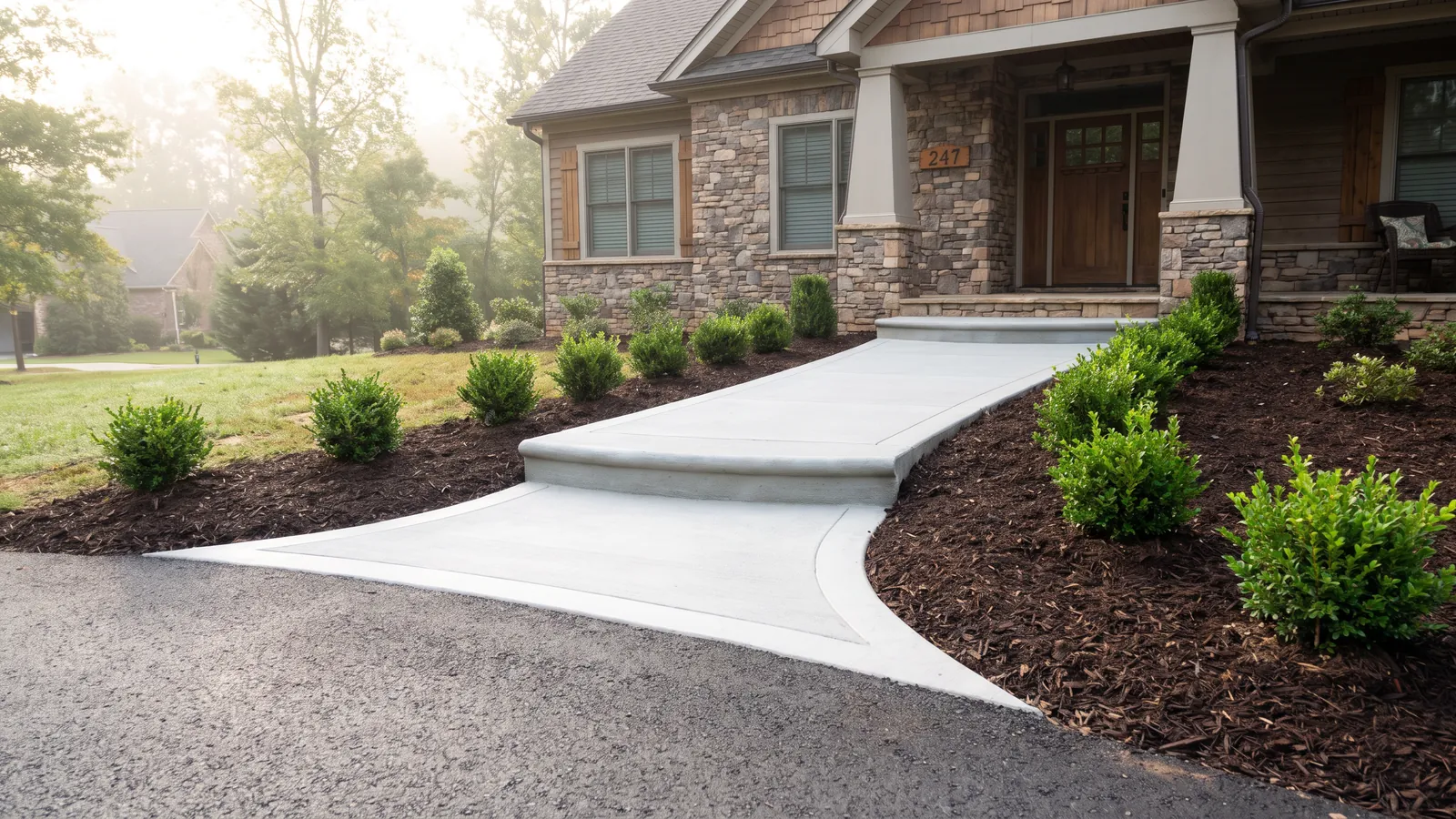
Walkways get less thought than driveways and more use. The path from the driveway to the front door is walked a dozen times a day, in the rain, in the dark and on the handful of icy mornings the Upstate gets each winter. It also happens to be the slab most likely to be poured straight on dirt, because it is small and the builder was finishing up. The result is the familiar Greer front walk: a section that has sunk an inch where the downspout empties, a lip at the porch, cracks every few feet, and a surface that has flaked where it was never sealed.
We pour walks the way we pour everything else, scaled down. The path is excavated past the topsoil, a compacted stone base goes in, and the forms are set to a gentle cross-slope so water sheds off the side rather than running down the length of the walk to the door. The slab is four inches thick, reinforced with mesh or fiber, and the control joints are cut close together, roughly every four feet on a four-foot walk, because a long narrow slab shrinks along its length and wants to crack across it. The finish is a broom finish for grip, or an exposed aggregate or stamped surface where the walk is part of the front landscaping, with a steeper broom on any slope.
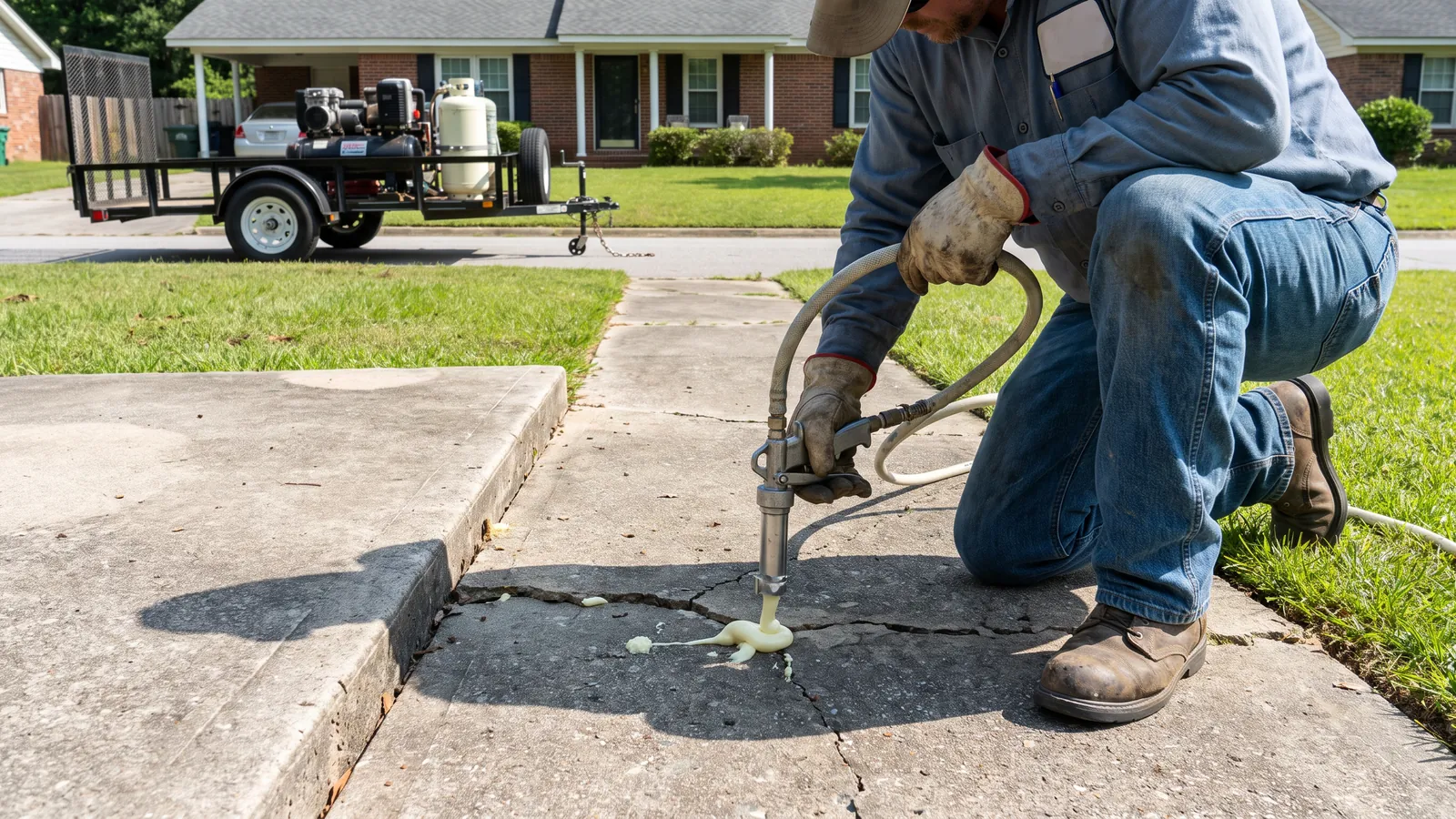
The same approach covers side paths to the gate and the trash cans, garden paths, the pad outside the back door, pool decks with a non-slip finish and a drain, and the walkway-plus-steps combination most Greer front yards need because the lots are rarely flat. Where a walk has only settled, foam leveling lifts it back for far less than a replacement; where it has cracked and heaved, the estimator will say so and price the new walk.
What the job includes
Stone base, even for a walk
Excavation and compacted crushed stone under every walkway, because small slabs on clay heave just like big ones.
Cross-sloped to shed water
A gentle fall to one side so rain leaves the walk instead of running to the door and freezing there in January.
Joints every few feet
Control joints spaced for a narrow slab and cut the same day, so the walk cracks in the joints and nowhere else.
Grip underfoot
Broom finish as standard, a heavier broom on slopes, exposed aggregate or gritted sealer around pools.
Downspouts handled
The spot where the gutter empties onto the walk gets a splash block, an extension or a drain so the base is not washed out.
Steps and landings
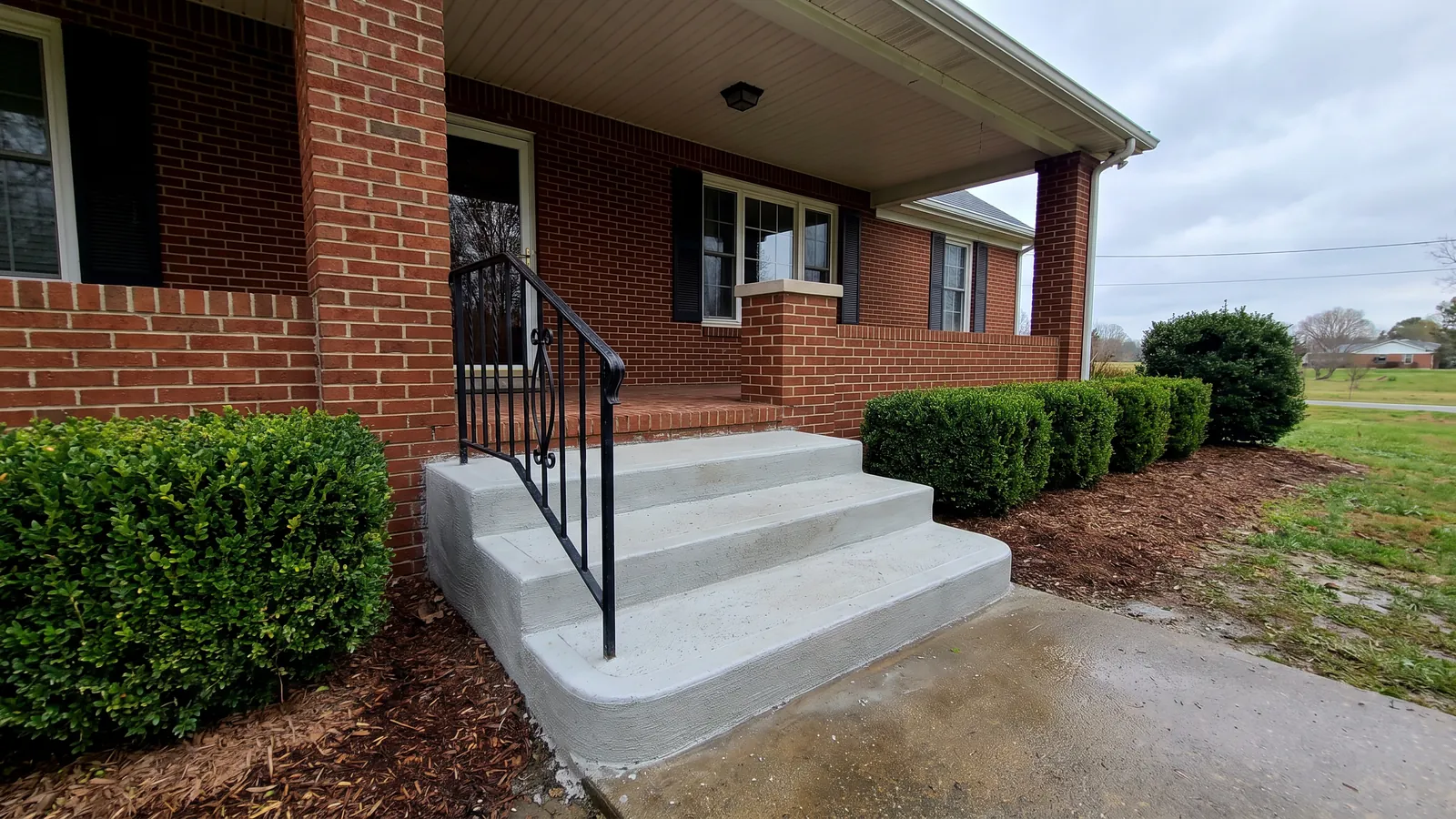
Poured together with the walk where the grade needs them, with even risers and a level landing at the door.
Sidewalks and walkways prices in Greer, SC
| Work | 2026 range | What changes it |
|---|---|---|
| Sidewalk or walkway, broom finish, per sq ft | $6 – $12 | Width, length and access |
| Typical 4 × 30 front walk | $720 – $1,440 | At the range above |
| Exposed aggregate or stamped walk, per sq ft | $8 – $25 | Finish chosen |
| Walk with poured steps | Walk rate plus steps | See concrete steps |
| Pool deck, broom or exposed aggregate | Per sq ft as above | Drainage and coping details |
| Lifting a settled walk instead | $5 – $15 per sq ft | See leveling |
| Sealing, per sq ft | $1.50 – $4 | Every two to three years |
Budgeting ranges for the Upstate in 2026, drawn from current contractor cost guides. Your figure is written after the estimator has measured the site and checked the ground, and it is itemized so you can see where the money goes.
On site
Sidewalks and walkways questions, answered
How wide should a front walk be?
Four feet lets two people pass and matches most front doors and porches. Three feet is fine for a side path to the gate or the trash cans.
Why does my walk have a lip at the porch?
The walk settled and the porch, which sits on a footing, did not. Foam leveling usually brings the walk back up; if the slab is cracked through, it gets replaced on a proper base.
Can you pour a walk that is not straight?
Yes. Curves are formed with flexible forms and are a nice fit for the sloped, wooded lots around Greer; the joints are placed so they read as part of the curve.
What about ice?
A walk with a cross-slope dries fast after rain and has little standing water to freeze. A broom finish gives grip on the few icy mornings; a smooth trowel finish does not, which is why we do not use it outdoors.
Do you replace city sidewalks?
The public sidewalk along the street belongs to the city or the county, and work on it usually needs their approval. We can quote it and handle the paperwork, or point you to the right office.
How soon can I walk on it?
Next day for foot traffic. Keep wheelbarrows and heavy loads off for a week and seal it after about a month.